The next leak doesn't wait for page two.
A plumber, electrician or HVAC company doesn't wait for customers to walk in — they drive out to a whole service area, often well past the next neighbourhood. SeoMap grids that entire area, not just the block around the workshop, and shows exactly which suburbs still see the business on Google Maps and which ones already only see a competitor — including the emergency searches that convert fastest.
Built around what you actually do all day.
- 01
Grids sized for a service radius, not a shopfront
A trade business's real customers can be scattered across an entire town or county, not clustered around a physical location nobody visits. Grid size and point spacing (5×5 up to 15×15) are fully configurable, so the scan can cover a genuine service radius instead of the tight radius that makes sense for a retail storefront.
- 02
Emergency keywords behave differently
"Notdienst Elektriker" or "emergency plumber" can return a completely different map pack than "Elektriker" or "plumber" at the same coordinate — Google weighs 24/7 availability and speed signals differently for urgent searches. Run them as separate scans, or import Google Search Console data to pre-fill the trade-specific terms customers actually searched in the last 90 days.
- 03
Multi-branch trade companies
A regional HVAC or electrical company with several branches — or a common trade name that a dozen unrelated businesses also use — is matched project by project via Google CID/Place-ID, not by name, so branches and unrelated competitors never get confused in the data.
- 04
Seeing which suburb to expand into next
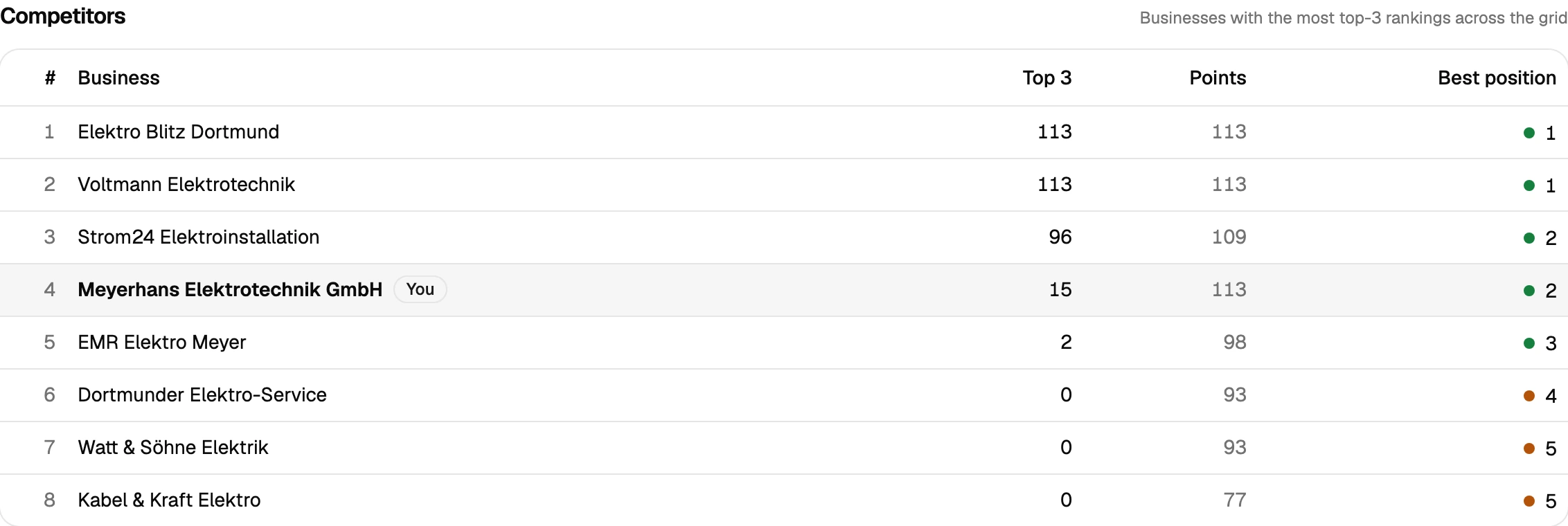
Competitor analysis ranks every business that shows up across the grid by how often it lands in the top 3. For a trade business weighing where to open a second location or push ads next, that's a direct read on which suburbs are already covered by a strong competitor and which ones are still open.
- 05
Proof for a client who's paying by the month
Trade businesses are common agency clients precisely because the ROI has to be provable. Scan comparison lays two grids side by side with the delta per point — improved, dropped, new, lost — so a retainer's value shows up as a map, not just a promise.
Why “service area” is the wrong-sized grid for most tools
Most local-search tools default to a radius that makes sense for a shop someone walks into — a few hundred metres, maybe a kilometre. That default is close to useless for a plumber, electrician, HVAC company or any other trade whose actual customers are spread across a whole service area the business drives out to, often well beyond the neighbourhood the workshop sits in. A grid scan built for a coffee shop will make a trade business’s visibility look better or worse than it actually is, because it’s simply measuring the wrong area.
SeoMap’s grid is configurable up to 15×15 with adjustable point spacing specifically so it can be sized to match a real service area instead of a storefront. Run it on the trade’s core service keyword and it shows which suburbs the business still shows up in and which ones a competitor has already taken over — and because emergency searches (“Notdienst Elektriker”, “emergency plumber”) often pull a different map pack than the non-urgent version of the same query, running both separately shows whether the business is actually visible in the moment that converts fastest: when something’s already broken.
For an agency running this for a trade client, that combination — the right-sized grid, urgent-vs-routine keyword separation, and a scan comparison after a Google Business Profile update or new landing page — is what turns “we did some local SEO” into a map the client can look at and understand in ten seconds, with the Agency plan covering the volume once there’s more than one trade client to run this for.
Prepare your measurement
Questions we actually get asked.
Our service area is much bigger than a neighbourhood — does grid scanning still work?
Yes — grid size and spacing are fully configurable up to a 15×15 grid, so a scan can cover a genuine multi-suburb or countywide service radius instead of a shopfront-sized area.
Can I track emergency/"Notdienst" keywords separately from regular service keywords?
Yes, and you should — "emergency plumber" and "plumber" routinely return different map packs at the same coordinate. Run them as separate scans to see whether the business shows up when it matters most.
We have several branches or service areas — can I keep them separate?
Yes. Each branch is its own project, matched to its Google listing by CID/Place-ID rather than by name, so branches — or two unrelated businesses sharing a common trade name — stay separate.
Our trade name is generic and other businesses nearby use something similar — will that cause mix-ups?
No. Matching by CID/Place-ID instead of business name is specifically what prevents that — a common name like "Elektro Schmidt" gets linked to the exact listing you selected, not a guess based on the name.
Is there a trial before I commit a marketing budget to this?
Yes — 500 free credits on signup, no credit card. Enough to run a couple of real scans across the service area before deciding on a plan.
Can I pull the data into another tool, or do I need to read every scan myself?
Both are covered. A read-only REST API ships with every plan — self-managed, revocable keys, endpoints for projects, scans and individual grid points — so you can wire results into Zapier, n8n or your own reporting. Every completed scan also gets a short AI-generated analysis paragraph automatically, on top of the existing rule-based breakdown, so you're not staring at a raw grid trying to figure out what changed.
Lay the map over your service area.
The first scan takes under three minutes. After that you’ll see your visibility the way your customers do.